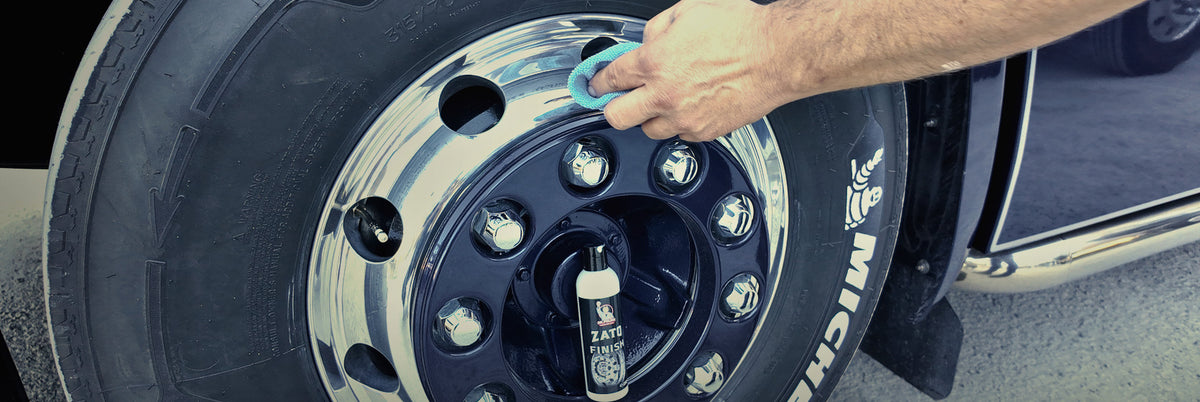
Truck Wheel Polishing

Truck Wheel Polishing

Everything you need to bring aluminium truck wheels to a high shine by hand: alloy wheel polish for wet application, abrasive polishing pads from P1000 to P8000 and the accessories to go with them. No polishing machine needed, and wet application keeps aluminium dust from becoming airborne.

Truck Wheel Polishing

  • Product label: NEU
ZATO PUCK 100 g – geöffnete Dose mit grauer Metallpolitur, Deckel daneben ZATO PUCK – feste Metallpolitur mit DR.POLISH-Prägung
  • Product label: NEU
ZATO FINISH 250 ml Metallpflege- und Glanzpolitur – Flasche ZATO FINISH 250 ml – Flasche Vorderseite
  • Product label: NEU
ZATO FINISH Set – FINISH 250 ml und gelbe Mikrofaserrolle ZATO FINISH Set – Mikrofaserrolle stehend mit FINISH-Flasche

More on this topic Truck Wheel Polishing

Polishing an alloy wheel doesn’t mean sanding until it shines. It means refining the surface in the right order until it reflects light evenly. Skip a grade and you’ll leave the scratches from the previous pass behind. On truck wheels, one question comes before all the others: is the wheel bare or coated? Most aluminium truck wheels have an extremely thin protective finish rather than paint. It’s called Dura-Bright, a treatment from Alcoa. It keeps its shine without polishing and must not be polished.

Why polishing truck wheels differs from polishing car wheels

On a car, an 18-inch wheel is exposed and you can reach it from all sides. On a truck, you’re dealing with 22.5-inch wheels, the inner side of twin wheels and deposits of brake dust, road salt and grime that have built up over tens of thousands of kilometres.

Then there’s the number of wheels. An articulated truck has twelve wheels, each with two sides. Online guides allow two to three hours per car wheel. Apply that to a truck and you’re looking at a working week. That’s why the method, not the polish, determines how much work is involved.

Why you shouldn’t polish Alcoa Dura-Bright wheels

People often search for ‘how to polish Alcoa Dura-Bright wheels’, but the question starts from a misunderstanding. Dura-Bright isn’t paint. It’s an extremely thin protective layer that maintains its own shine. Don’t polish it. Abrasive compounds wear away the layer, leaving a patch that oxidises and no longer matches the surrounding finish.

These wheels need cleaning, not polishing. Alcoa specifies Dura-Bright Wheel Wash for the job. The source lists Pipifein, which pairs PUCK with a P8000 pad, as a fallback if washing isn’t enough. That conflicts with the instruction not to polish Dura-Bright, so don’t treat it as approval to use an abrasive on the finish.

Never use ALpolish on Dura-Bright The compound is made for uncoated aluminium. On a coated wheel, its abrasive action will permanently damage the finish.

Polishing alloy wheels: which grits to use and in what order

On uncoated aluminium, the sequence is P1000, P2000, P5000 and P8000. Each grade has one job: to remove the marks left by the previous one. Jump straight from P1000 to P8000 and you’ll polish over the coarse scratches instead of removing them. Afterwards, they’ll all show up in angled light.

You’ll find very different sequences online, from 80 to 600 grit in steps of a hundred, or 600, 800 and 1200. These come from car wheel refurbishment, where a layer of paint is removed first. On bare aluminium, 80 grit isn’t a starting point. It leaves damage you’ll spend the next four stages working out.

Polishing alloy wheels by hand without airborne aluminium dust

Conventional metal polishes are used dry. The material they remove ends up as black aluminium dust on your hands and clothes and in the air you breathe. DR.POLISH ZATO PUCK is a solid polish for wet use. You work with water, which keeps the residue wet rather than airborne, and you don’t need a machine or dust extraction for this hand-polishing method.

For uncoated Alcoa wheels, the manufacturer also offers its own ALpolish compound. Which of the two suits the job depends on the finish and whether you’re working by hand or machine, not on the price.

Polishing aluminium truck wheels: how useful are online estimates?

Two to three hours per wheel, at least 45 minutes, €100 to €300 at a detailing shop: you’ll see these figures everywhere, and they contradict one another. They come from car detailing and tell you little about a 22.5-inch truck wheel.

We don’t time the work ourselves, so we don’t quote timings. What we can say is that the work depends on the condition of the wheel, not its size. A regularly washed wheel just needs a refresh with the finest grade. One that’s been neglected for ten years needs the full sequence.

How to keep alloy wheels shiny after polishing

Polished aluminium is bare, so it has no protection. Brake dust can bake on again, road salt can attack the surface, and after a winter you’re back to doing the same work.

That’s why a sealant goes on after polishing. Truck Wheel Ceramic is designed for the job. Start with a clean wheel: Alcoa specifically recommends letting the wheel cool to below 35 °C before cleaning, as cleaner can dry on hot metal and leave marks.

FAQs about Truck Wheel Polishing

Can you polish painted alloy wheels?

Only the paintwork, not the aluminium underneath. A painted or powder-coated wheel has a protective layer. If you polish through it, you expose bare metal that starts oxidising straight away. Stick to cleaning and sealing these wheels. Polishing the aluminium itself is only an option on uncoated wheels.

Do you need a polishing machine?

No. On wheels, working by hand is often the better choice. A rotating disc struggles to reach the curves between spokes and the area around the wheel nuts. A hook-and-loop hand pad with the right abrasive grade can reach those spots, and working wet keeps aluminium dust out of the air.

How often do polished alloy wheels need repolishing?

It depends on whether the wheel is sealed. Without a protective layer, brake dust sticks directly to the bare aluminium, and a winter on salted roads can take away the shine. With a sealant, a normal wash is usually enough. You only need to go through the full polishing process again once the coating starts to wear off.

Can you polish out deep scratches?

Polishing smooths the surface, but it won’t remove a scratch that’s deeper than the coarsest stage can take out. Trying to sand it away with coarse paper can leave a dip that shows up more clearly in angled light than the original scratch. Leave deep damage to a specialist workshop.

How long does it take to polish an alloy wheel?

The honest answer is that it depends on the condition of the wheel, not its size. A well-maintained wheel only needs the finest stage. One with baked-on brake dust and salt corrosion needs the full sequence from P1000 upwards, and that takes time. Timings from car detailing guides don’t carry over to a 22.5-inch truck wheel.

Free delivery

Delivery to Austria and Germany is free on orders of €140 or more.

SUPPORT

Got a question or need something clarified? Just email us any time at: info@DR-POLISH.at

SECURE PAYMENTS

Pay by PayPal, credit card, Klarna or advance bank transfer. Payments are encrypted through Shopify Payments.