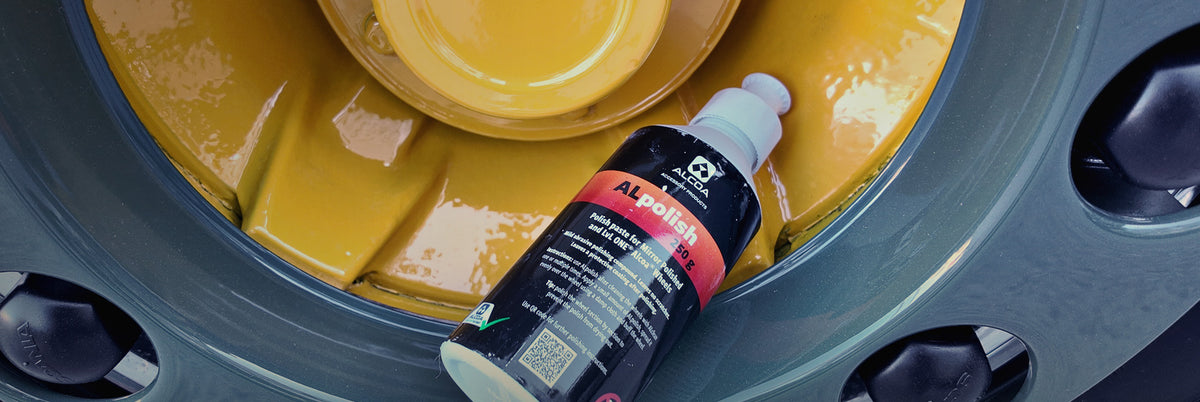
Aluminium Polish & Compounds

Aluminium Polish & Compounds

Polishes for bare, uncoated aluminium: a solid polish for hand application, a liquid polish for machine use and a fine finishing polish for light scratches and polishing marks. All are used wet to keep black aluminium dust from becoming airborne.

Aluminium Polish & Compounds

  • Product label: NEU
ZATO PUCK 100 g – geöffnete Dose mit grauer Metallpolitur, Deckel daneben ZATO PUCK – feste Metallpolitur mit DR.POLISH-Prägung
  • Product label: NEU
ZATO FINISH 250 ml Metallpflege- und Glanzpolitur – Flasche ZATO FINISH 250 ml – Flasche Vorderseite
  • Product label: NEU
ZATO Special Set 12-teilig – Polituren, Mikrofaserrolle, Waschhandschuh, Schleifscheiben und Drucksprühgerät ZATO Special Set 12-teilig – alle Teile im Überblick

More on this topic Aluminium Polish & Compounds

Dull aluminium doesn’t need a miracle product. It needs the right aluminium polish for the stage you’re at. Bare aluminium is soft and develops a grey layer on contact with air. Polish takes that layer off, provided you’re working on bare metal rather than a coated finish. DR.POLISH stocks the ZATO range for this work, developed on truck wheels and aluminium tanks.

Oxidised, anodised or coated: why the finish matters

These three finishes can look alike, but they need different treatment. Oxidised aluminium is bare metal that has formed a thin grey layer on contact with air. That’s normal, and polish can remove it. Anodising thickens and colours that layer electrochemically so that it becomes the protective finish itself. Polish it away and you expose the soft aluminium underneath. A coated surface has paint, powder coating or a factory-applied protective finish such as Alcoa’s Dura-Bright.

The test takes ten seconds. Rub briefly with a damp cloth, using a little pressure. If the cloth picks up grey-black residue, the aluminium is bare. If it stays clean, there’s a layer over the metal, so clean it rather than polishing it.

Aluminium polishing paste, solid polish or liquid polish: which to use

The format determines how you apply the polish, not how aggressively it cuts. ZATO PUCK is a 100 g solid aluminium polish for hand use. Work wet and apply pressure as you go. ZATO METAL POLISH is a liquid aluminium polish for machine use only: the machine’s speed breaks down the abrasive particles in a controlled way.

ZATO FINISH is the final stage, an aluminium polish that removes only micro-scratches and polishing marks. The right compound depends less on the metal than on the condition of the surface. The same sequence applies to stainless steel, brass and chrome.

Polishing aluminium on motorbikes, classic cars and boats: when to work by hand

A machine is quicker on large, uninterrupted surfaces. On smaller parts, working by hand is faster because there’s no machine to set up or edges to mask off. You can do a headlight ring, a piece of classic car trim, a motorbike engine block or a boat fitting in a few minutes, before you’ve even got the machine ready.

The key is to keep the surface wet. When you work dry, the residue breaks down into black dust that settles in every gap. Water traps the residue as it forms, cools the surface and helps the polish glide. On soft aluminium, that can make the difference between a clean shine and a hazy finish.

Polishing alloy wheels: the wheel barrel is where most of the work is

The face of the wheel is what everyone sees, but the barrel is where most of the surface area is. It’s where you can keep the machine moving, where baked-on brake dust collects and where you’ll see whether the finish reflects evenly or stays patchy. Work by hand on the face itself, between the spokes.

If you’re doing a full set or a fleet, split the job into two passes: machine-polish all the barrels first, then do all the wheel faces by hand. For a step-by-step example on a dull truck wheel, see truck wheel refurbishment.

Scratches in aluminium: what polish can’t remove

Polish works at the scale of micrometres. It removes tarnish, polishing marks and fine sanding scratches, but that’s as far as it goes. The fingernail test tells you what you’re dealing with: if your nail catches in the scratch, it’s too deep for polish.

Start one step earlier, with sanding discs in the right grit. Work through the grades in order, so each one only has to remove the marks left by the previous pass. Otherwise, you’ll spend longer trying to work out marks the finer grade wasn’t made to remove. Don’t start polishing until the sanding pattern is even.

Why bare aluminium tarnishes again and what you can do about it

Polishing doesn’t change the chemistry of aluminium. It just makes the surface smoother. A smooth surface oxidises more slowly because moisture and salt have less surface to attack. It’ll still tarnish eventually, and how quickly depends on the weather, exposure to road salt and how long the surface is left untreated.

There are two ways to keep the shine. Touch it up regularly with FINISH, which takes a few minutes per area, or apply a protective coating so water beads off and brake dust doesn’t stick as readily. You can do both: apply the sealant to a freshly polished surface, never to a dull one.

FAQs about Aluminium Polish & Compounds

Which polish is suitable for aluminium?

It depends on the condition of the surface, not the metal itself. If it’s dull or tarnished, start with METAL POLISH by machine or PUCK by hand. If it’s already well maintained and just has a few polishing marks, FINISH is enough.

How do I make dull aluminium shiny again?

Work in stages. First, clean the surface thoroughly so you don’t rub dirt into it. Use the first polish wet until you’ve removed the grey layer. You’ll see the cloth turn black as you work. Then use the fine finishing polish to bring up a mirror shine. Deep defects need sanding first, or they’ll still be visible after polishing.

Can I polish anodised aluminium?

It’s best not to. Anodising thickens the surface layer electrochemically, so the layer itself protects the aluminium. An abrasive polish wears it away, leaving an exposed patch that oxidises unevenly. The damage is visible and can’t be undone. The same applies to powder-coated and painted surfaces.

What’s the best aluminium polish?

There’s no single best aluminium polish because it depends on which stage you need. A coarse polish can leave streaks on a well-maintained surface, while a fine polish won’t do much on heavily weathered aluminium. Ask what condition the surface is in: is it weathered, matt or just a little dull? That tells you where to start.

How do I remove scratches from aluminium?

Check the scratch with your fingernail. If your nail doesn’t catch, you can polish the scratch out. If it catches, the scratch is too deep for polish alone. Start with a grit that can remove it, then work through progressively finer grades until the sanding pattern is even. Only then should you polish.

Can I polish my own alloy wheels?

Yes. It’s more a question of time than skill. A heavily weathered wheel can take several hours the first time, while one that’s just dull takes considerably less. The essentials are a variable-speed machine, plenty of water and patience between stages. If you’d like someone to guide you through it, join a workshop.

Free delivery

Delivery to Austria and Germany is free on orders of €140 or more.

SUPPORT

Got a question or need something clarified? Just email us any time at: info@DR-POLISH.at

SECURE PAYMENTS

Pay by PayPal, credit card, Klarna or advance bank transfer. Payments are encrypted through Shopify Payments.